Home Maintenance Blog

Automatic Washing Machine Shaking Violently or Not Draining? Common Causes & Fixes

Modern front-load and top-load automatic washing machines (such as Samsung, Haier, Dawlance, LG, and Super Asia) make laundry seamless—until the machine begins banging against the wall during its high-speed spin cycle or stops mid-wash with a tub full of dirty soapy water.

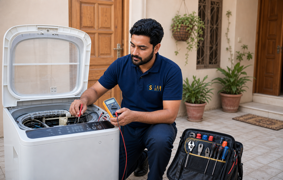
When washing machines fail in Islamabad and Rawalpindi, homeowners frequently struggle to diagnose whether the fault is a simple blocked drain filter or an expensive PCB motherboard breakdown. Here is how to diagnose and resolve the two most common washing machine failures.

Issue 1: Machine Vibrates or Shakes Violently on Spin Cycle

If your washing machine starts walking across the floor or makes a violent thumping sound during the rinse and spin phase, check the following:

1. Unbalanced Feet or Slanted Floor

Automatic washers rotate at 800 to 1400 RPM. If one of the four leveling feet is loose or not firmly planted on the floor tile, high centrifugal forces cause violent wobbling. The Fix: Use a spirit level and adjust the locknut on each foot until the unit does not rock when pushed diagonally.

2. Broken or Worn Suspension Damper Rods (Top-Load Units)

Top-load automatic washers suspend the entire inner drum with four spring-damped suspension rods. Over 2 to 4 years of regular laundry loads, the grease dries out or the springs weaken unevenly. The tub knocks loudly against the outer cabinet walls. The Fix: Replacing all four suspension rods simultaneously restores perfect balance.

3. Worn Tub Bearings and Spider Arm (Front-Load Units)

If your front-load machine roars like an airplane taking off during spin, water has breached the tub seal and degraded the heavy-duty ball bearings. The Fix: Bearing replacement and spider bracket inspection before drum misalignment damages the outer tub.

Issue 2: Water Won’t Drain / Machine Halts with Error Codes (E2, OE, 5E)

When the wash cycle finishes but the tub remains full of water, the machine displays a drain error and refuses to unlock the door or begin spinning.

1. Blocked Coin Trap / Lint Filter

Every automatic washing machine features a coin filter located at the bottom-right front panel (on front loaders) or at the drain outlet. Coins, safety pins, hairpins, and lint frequently clog the filter chamber, blocking water discharge. The Fix: Place a shallow tray on the floor, open the emergency drain plug, unscrew the filter counterclockwise, and remove any caught foreign objects.

2. Jammed or Burned Drain Pump Motor

If the filter is clean but you hear a faint humming sound without water being pumped out, a small object (like a coin or button) has seized the drain pump impeller blades, or the 220V pump motor coil has burned out. The Fix: A technician disassembles the pump housing, removes the obstruction, or installs a new universal magnetic drain pump.

Should You Repair the Motherboard (PCB) or Replace the Machine?

When an error code appears (such as power failure, motor drive error, or erratic LED blinking), many service centres immediately recommend buying a new motherboard costing Rs. 15,000 to Rs. 25,000. In reality, over 70% of PCB issues are caused by faulty capacitors, burned relay switches, or corroded solder traces that can be professionally repaired at component level for a fraction of the cost.

Professional Doorstep Washing Machine Repair Across Islamabad & Rawalpindi

Do not let laundry pile up. HomesServices certified appliance technicians provide comprehensive on-site diagnostics and component-level repairs for Haier, Samsung, Dawlance, LG, and all major automatic washing machine brands across the twin cities.

  • Fixed Rs. 500 inspection fee (adjusted against completed service).
  • Suspension rod replacement, drain pump clearing, drum bearing servicing, and PCB motherboard repair.

Book Washing Machine Repair → or explore our full range of Home Appliance Services.

How to Protect Home Appliances from Voltage Fluctuations and Loadshedding

When grid power abruptly cuts off during loadshedding—and especially when it suddenly surges back on—thousands of households in Islamabad and Rawalpindi suffer blown refrigerator compressors, fried inverter AC motherboards, and burned LED TV power supply boards.

Modern inverter appliances rely on microprocessors that are exceptionally sensitive to voltage transients, frequency fluctuations, and inductive back-EMF spikes. In this guide, HomesServices verified electricians outline the 5 most effective measures to safeguard your home appliances.

1. Install a Main Digital Voltage Protector with Delay Timer

The single greatest hazard to household appliances is not the power outage itself, but the initial surge when electricity returns. Grid restoration often brings erratic voltage swings ranging from 280V down to 140V for the first 10 to 60 seconds.

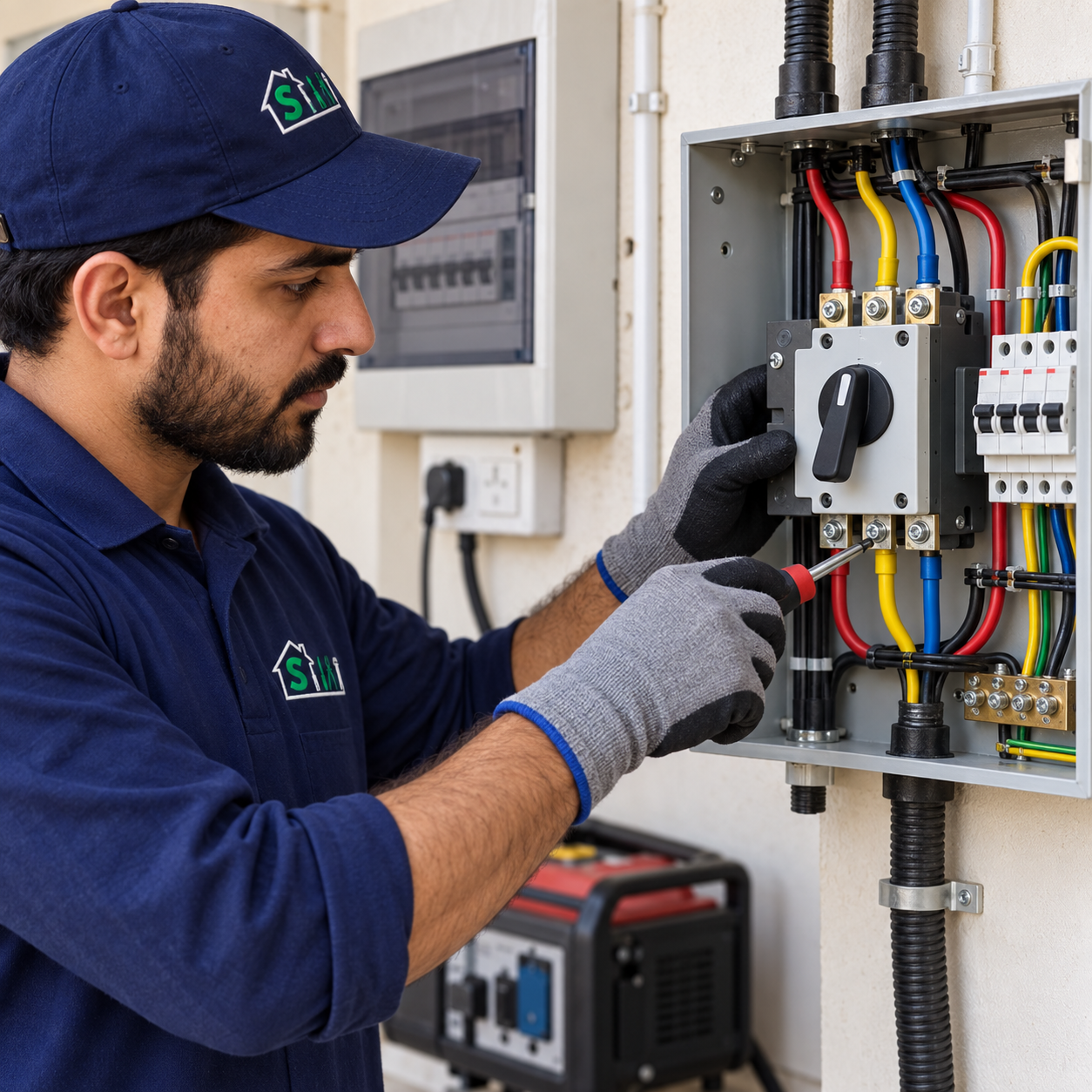
  • The Solution: Install an automated DIN-rail digital over/under-voltage protector directly inside your main distribution board (DB).
  • The Benefit: It disconnects power instantly when voltage exceeds 250V or drops below 175V, and only restores power after a safe 60-to-180 second stabilization delay.

2. Replace Risky Knife Switches with Dual-Power Automatic Changeovers

Manual rotary or knife switches cause heavy arcing, loose contact resistance, and occasional phase short circuits if switched while high-current appliances (like motors or geysers) are running.

Modern dual-power Automatic Changeover Switches (ATS) switch between WAPDA, UPS, or generator in milliseconds without sparking, eliminating dangerous human error and contact chatter that damages electronics.

3. Ensure Pure Sine Wave Inverters for Sensitive Loads

Square-wave or modified sine-wave backup units create electromagnetic harmonics that cause ceiling fans to buzz loudly and generate extreme internal heat inside transformer-less electronic power supplies (laptops, routers, automatic washing machine PCBs).

If you run modern electronics on backup power, always ensure your UPS or solar inverter produces a true pure sine wave waveform.

4. Test and Verify Earth Grounding (Earthing)

Many older residences in Rawalpindi and outer sectors of Islamabad have disconnected or deteriorated earth-pit earthing. Without a low-resistance path to earth, static charges and surge suppression circuits (MOVs) inside appliance protectors cannot discharge dangerous voltage spikes, exposing appliance metal chassis to current leaks.

5. Dedicated Miniature Circuit Breakers (MCB & RCCB)

Ensure heavy load appliances (Inverter ACs, Instant Geysers, Water Motors, Washing Machines) are wired to individual, correctly rated MCBs rather than daisy-chained to general 5A lighting circuits. An RCCB (Residual Current Circuit Breaker) should also be installed to trip on any current leakage before it can cause fatal shock or electrical fires.

Schedule a Distribution Board & UPS Inspection in Islamabad or Rawalpindi

Protect your expensive household investments. HomesServices licensed electricians carry out DB rewiring, automatic changeover switch installation, breaker replacements, and earth testing across all sectors of Islamabad and Rawalpindi.

  • Transparent Rs. 500 inspection fee (adjusted against completed work).
  • Clean, safe wiring up to national electrical safety standards.

Book UPS & Changeover Installation → or browse our complete Electrician Services.

Why Your Water Motor Hums But Won’t Start: 4 Common Causes & Solutions

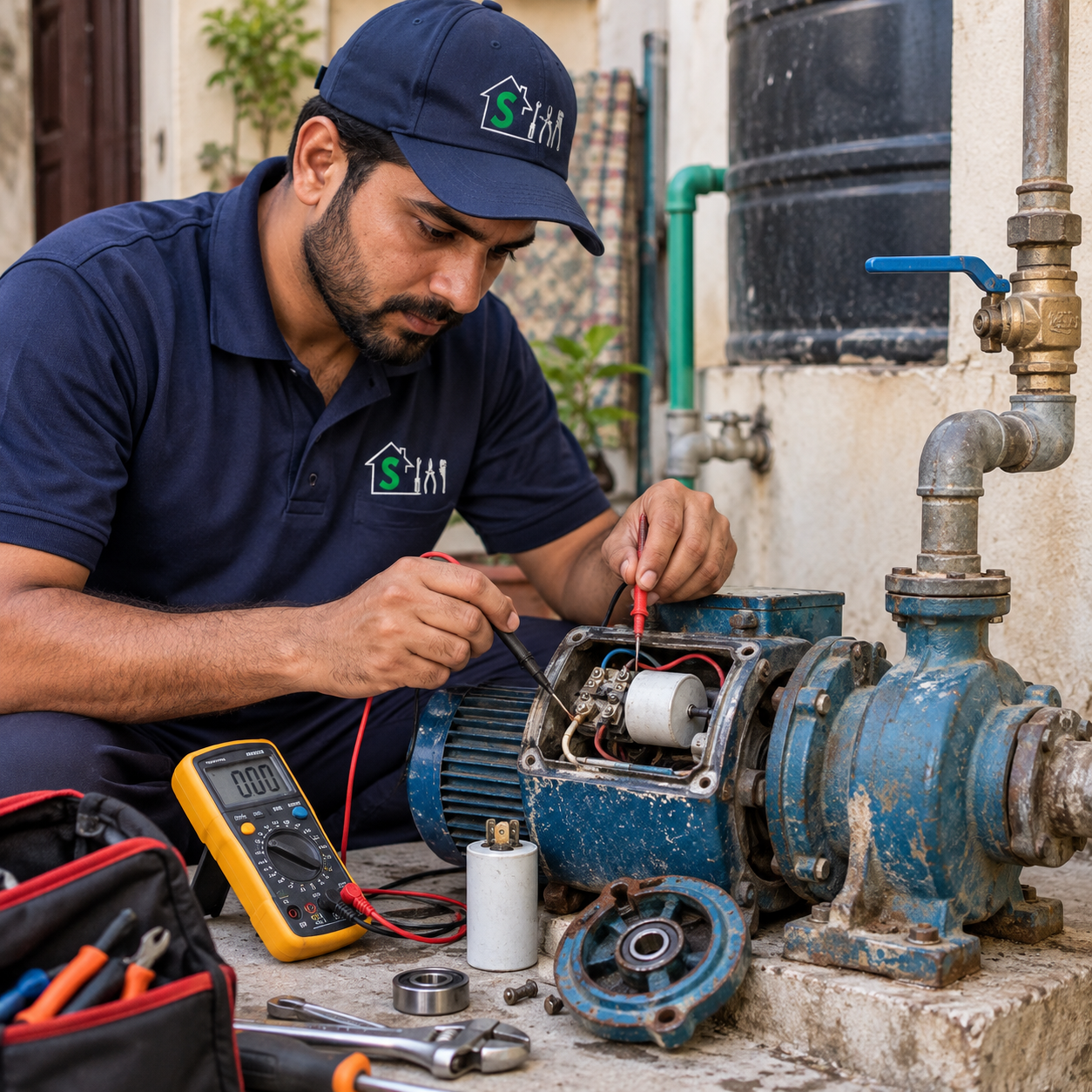
You switch on your underground or overhead water motor, expect the familiar hum of running water, but all you hear is a deep, loud buzzing or humming sound with zero water flow. Left running, the motor gets burning hot and trips the circuit breaker or smokes.

This is one of the most frequent plumbing emergencies reported by households across Islamabad and Rawalpindi. In this guide, our certified plumbing technicians explain the 4 most common causes of water motor humming, how to diagnose them safely, and what repair involves.

1. Burned or Weak Starting Capacitor (Most Common)

Single-phase electric water pumps (typically 0.5 HP, 1.0 HP, or 1.5 HP units used in Pakistani homes) rely on a run or start capacitor to create the rotating magnetic field required to initiate shaft spinning.

  • The Symptom: The motor hums steadily. If you turn off the switch and try to spin the motor shaft with a screwdriver through the rear fan cover, it rotates freely with no physical resistance.
  • The Cause: Voltage surges during loadshedding recovery or age degrade the capacitor’s internal dielectric material, leaving it unable to produce the startup torque.
  • The Fix: Testing the capacitor microfarad (uF) rating and replacing it with a correctly matched heavy-duty replacement. Never leave a humming motor running with a dead capacitor—the stator windings will overheat and burn out within minutes.

2. Seized Impeller Due to Hard Water Scaling or Debris

Groundwater in several areas of Rawalpindi and sectors of Islamabad contains elevated mineral hardness. Over months of operation, calcium carbonate and iron scale accumulate inside the brass or bronze impeller housing.

  • The Symptom: When power is turned off, the rear motor shaft is completely stiff or impossible to turn by hand.
  • The Cause: Mineral scale, fine sand, or small pebble debris has physically wedged between the rotating impeller and the pump diffuser casing.
  • The Fix: The technician must open the pump head, descale the casing using non-corrosive descaling solvent, clear any obstruction, and verify smooth impeller clearance.

3. Worn Bearings and Mechanical Seal Failure

Water pump motors have two deep-groove ball bearings supporting the armature shaft. In front of the bearing sits a spring-loaded ceramic-and-graphite mechanical water seal that prevents pressurized water from penetrating into the motor chamber.

  • The Symptom: Prior to the motor refusing to start, it made a progressively loud screeching or grinding noise for days. You may also observe water continuously dripping from the gap between the pump casting and the motor body.
  • The Fix: Replacing the worn bearings and pressing in a brand-new ceramic mechanical seal. If ignored, leaking water enters the motor windings, causing a direct short circuit to earth.

4. Low Voltage from the Main Power Supply

During peak morning or evening hours in summer and winter, grid voltage in certain neighbourhoods can drop below 180V. Electric induction motors require adequate voltage to overcome initial starting resistance. Under severe low voltage, the motor cannot achieve starting torque and hums in place.

Safety Advisory: What You Should Never Do

  • Do NOT try to manually spin the fan blades while the power switch is turned ON. If the motor suddenly kicks in, spinning fan blades can cause severe hand injuries.
  • Do NOT keep flipping the switch repeatedly. If the motor fails to start twice, switch off the breaker immediately to protect the copper windings from burning out.

Need Fast Doorstep Water Motor Diagnostics in Islamabad or Rawalpindi?

HomesServices verified plumbers and motor specialists arrive equipped with diagnostic multimeters, replacement capacitors, and mechanical seals across Bahria Town, DHA, PWD, and all CDA sectors within 45 to 60 minutes.

  • Fixed Rs. 500 visiting/diagnostic fee (adjusted directly against repair bill).
  • On-site capacitor testing, seal replacement, and impeller descaling.

Book Water Motor Repair → or explore our complete Plumbing Services.

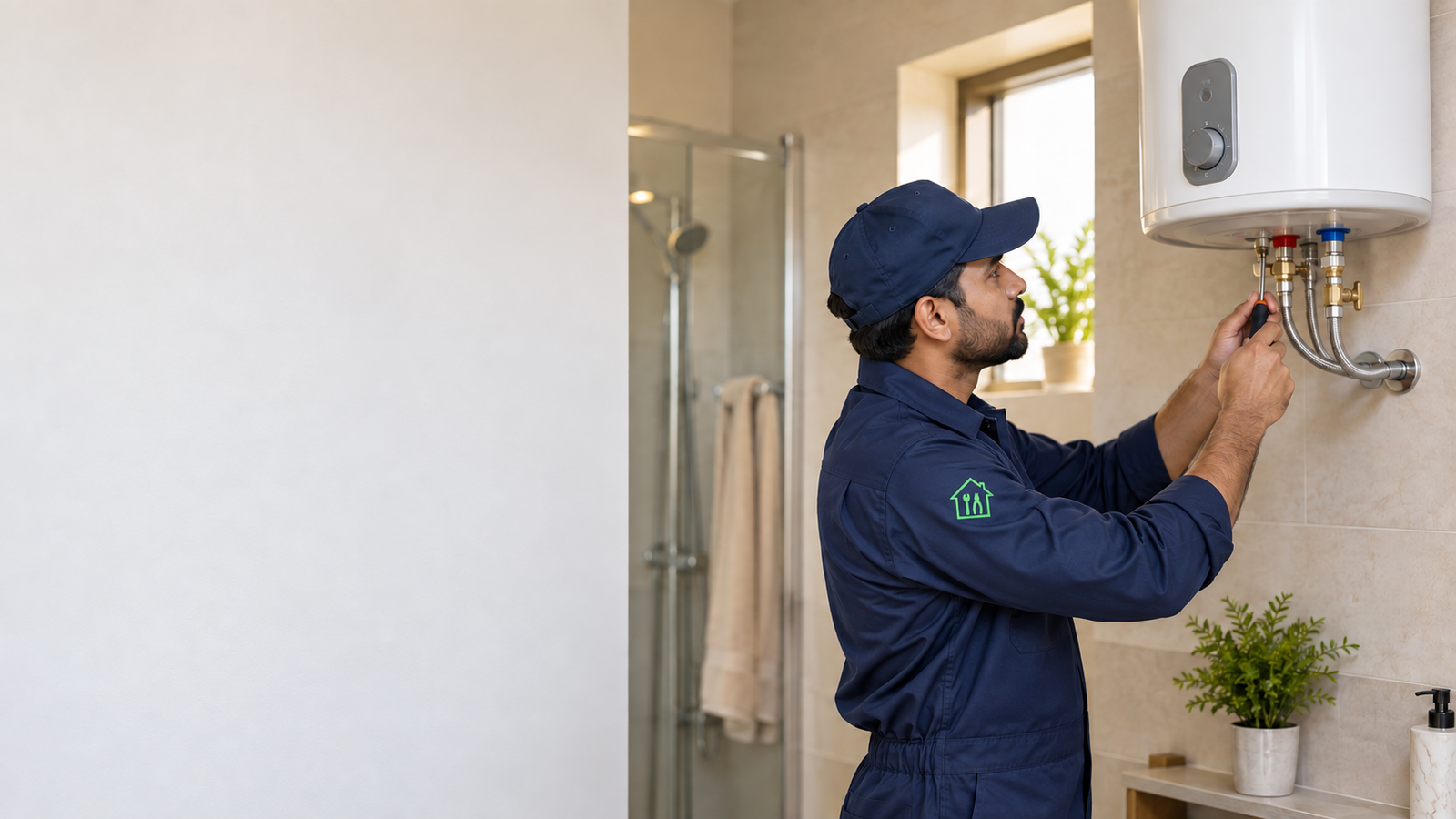
7 Warning Signs Your Geyser Needs Repair Before Winter

Cold mornings are not the time to discover that your geyser is not working properly. A small geyser problem can become inconvenient, unsafe, or more expensive if it is ignored before winter.

1. Water Is Not Heating Properly

If the water stays lukewarm or takes too long to heat, the geyser may need inspection before daily winter use increases.

2. Hot Water Runs Out Too Quickly

A sudden drop in hot water supply can point to thermostat, element, gas flow, or internal performance problems.

3. Strange Noises From the Geyser

Popping, rumbling, or unusual sounds should not be ignored. They may indicate sediment, pressure, or component issues.

4. Leakage Around the Unit

Water near the geyser, pipes, or valves needs quick attention because leaks can damage walls, flooring, and fittings.

5. Pilot Flame or Ignition Problems

If a gas geyser does not ignite smoothly or the flame keeps going out, avoid risky DIY fixes and request a professional inspection.

6. Rust, Smell, or Discolored Water

Rust marks, unusual smell, or dirty water can signal internal wear, pipe issues, or a need for maintenance.

7. The Geyser Has Not Been Checked Before Winter

Even if it is working, a pre-winter check helps reduce surprise breakdowns when demand is highest.

See Geyser Services Now

HomesServices helps customers request geyser repair and installation support in Islamabad and Rawalpindi.

Stay Warm This Winter: Is Your Inverter AC Ready for Heating?

Many inverter AC models can provide both cooling in summer and warmth in winter. Before depending on heating mode, check that your particular model supports it and arrange service if performance is poor.

  1. One AC for summer and winter
    A heat-and-cool inverter AC can help keep one room comfortable across seasons.
  2. Efficient temperature control
    Inverter technology adjusts output as room temperature changes, helping the unit operate steadily.
  3. More even room comfort
    A correctly working AC can distribute warm air through the room more consistently.
  4. Prepare before the cold starts
    Filters, airflow, drainage, electrical connections, and overall performance should be checked before winter use.
  5. Signs your inverter AC needs service
    Unusual noises, error codes, water leaks, weak airflow, or no warm air are good reasons to arrange an inspection.

Need AC service in Islamabad or Rawalpindi? View AC Services and book a suitable service request.

A qualified technician can assess the unit safely; do not attempt internal electrical repairs yourself.

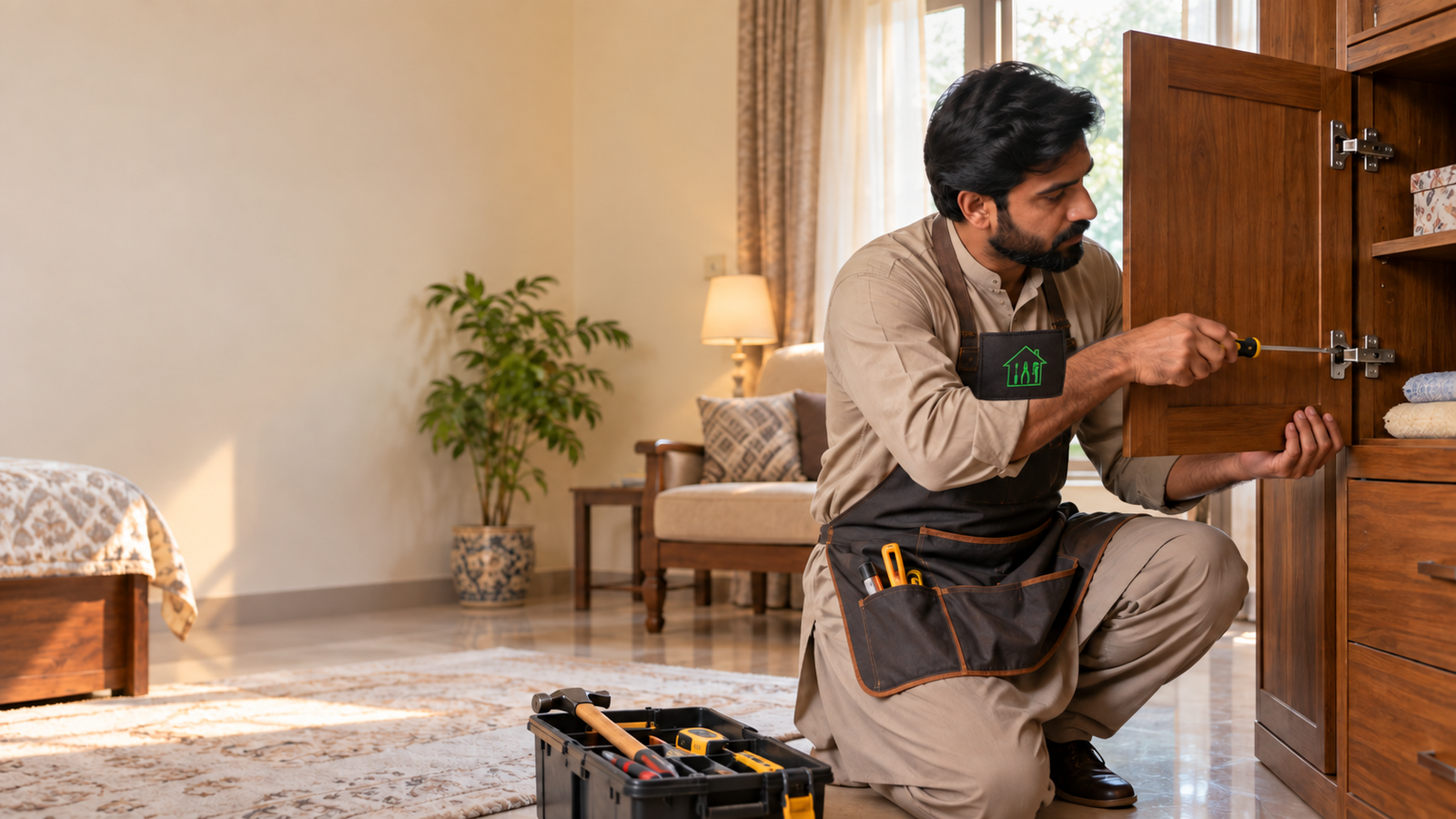
5 Signs Your Furniture Needs a Carpenter Before the Damage Gets Worse

Small furniture and woodwork problems can become inconvenient and costly when left untreated. A carpenter can help restore safety, function, and appearance before the damage spreads.

1. Doors or Cabinets Do Not Close Properly

If cabinet doors, wardrobes, or room doors are loose, stuck, or misaligned, the hinges, frame, or fittings may need repair.

2. Furniture Feels Shaky or Unstable

A wobbling bed, chair, table, or shelf can become unsafe. Early carpenter repair can prevent bigger breakage.

3. Drawers Are Jammed or Broken

Hard-to-open drawers often point to damaged runners, swelling wood, loose screws, or alignment issues.

4. Cracks, Chips, or Loose Wooden Parts Are Spreading

Visible cracks and loose wooden pieces should be repaired before they affect the full structure.

5. You Need Custom Fitting or Adjustment

Carpenter services are useful for curtain rods, shelves, cabinets, doors, locks, handles, and minor home woodwork adjustments.

See Carpenter Services Now

HomesServices helps customers request carpenter services for homes in Islamabad and Rawalpindi.

Exit mobile version